Archive
Category Archives for "Dominate Thoughts"How to dominate your thoughts to keep the negative bastards away and keep pumping out those serotonin feel-good thoughts.

How to dominate your thoughts to keep the negative bastards away and keep pumping out those serotonin feel-good thoughts.
How do you know if you feel bad because you have situational depression or if there’s something wrong with your brain and body?
Do you feel bad because you are going through a bunch of life transitions, you just lost your job, and are fighting with your spouse? Or is it because you aren’t eating right and your sleep is messed up?
The answer is, it depends.
It’s not always so black and white.
This video and post will go over the difference between situational and biological/physical depression and how they interact with each other.
However, some people have everything working properly in their bodies but events in their life are causing havoc on their emotional state.
For example, one of my best friends just died and it was probably suicide, I just learned that I am now struggling with bartonella or possibly lyme disease, I’m in a new town with hardly any friends, and under a lot of stress.
I felt really down, overwhelmed, sad, low energy, for a good 2-3 weeks. I felt out of control with everything going on and dealing with all the stressors. As I worked through the situation, despite nothing changing physically, the cloud starts to lift and the darkness goes away.
This could be you if you are moving to a new town, going to a new college, and having fights with your parents. This could be if you are having a major breakup. This could be if you just lost your job and you aren’t sure what you are going to do next.
Situational depression is when your external circumstances affect how you feel. It resolves itself through working through the problem, getting help, acceptance, feeling emotions, changing your cognitive thoughts, etc.

You Can Be a Hollywood Celebrity & Still Feel Depressed
Situational depression is vastly different from biological depression. With biological depression, you would be trapped in a state of depression regardless if whether or not you were living in a mansion with no worries or if you had every worry in the world.
For example, if you had a severe magnesium deficiency, you could be depressed with anxiety for years until you resolve the magnesium deficiency. It doesn’t matter how great your life is, your body needs more magnesium to be in balance and function properly.
Having depression that is biological means that your brain isn’t going to work right no matter what you do in the external world. It doesn’t matter if you are jumping out of a plane if you’re deficient in amino acids and b vitamins, your brain won’t even be able to produce the neurotransmitters to feel any pleasure at all.
I had depression really bad for about 11 years. At first, I thought it was all my fault and that my life just sucked. I tried riding a fast motorcycle, skydiving, running a marathon, etc. and I never felt happy at all. I did all the therapy in the world and still didn’t feel any different.
That’s because physically my body wasn’t working right. It would be like having a really good map, great friends as passengers in the car, and trying to get to a different state when your car’s engine has a leak. It doesn’t matter how many friends you have with you, or how much money you have, you aren’t getting to your destination as long as the car (your body) isn’t running properly.
This is also why antidepressants tend to work really well for a short-time, because they are changing what is happening inside your body, and therefore you see the world completely differently.
Unfortunately, they often come with a lot of side effects and in the long-run don’t solve the root problem. Then you are left still feeling horrible and now you have to deal with weaning off the antidepressant.
Solving the actual root causes of your depression can come in many different forms, from vitamin/mineral deficiencies, being allergic to certain foods, hormonal issues, etc.
When you have situational depression, you can fix the depression by changing your mindset or your lifestyle. If you have depression that is caused by physical root causes, it can only be fixed when you fix the root causes.
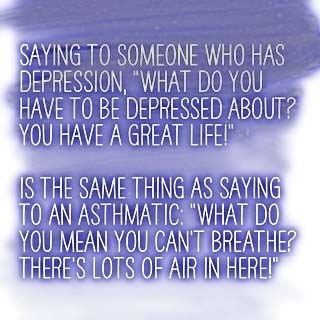
Sometimes I have people ask me if they should be doing therapy also. The answer is always yes, if it helps you. Getting as much help and support as you can is always a good idea.
Depression isn’t always just 100% situational or 100% biological.
Being physically depressed to where you have no energy can make it so you miss days at work. This causes you to lose your job. You then dig yourself into a hole and lose touch with friends, and now you are in both a physically and situationally bad place.
If someone you love dies and you lose your home, the stress can wear you out. Being worn down can cause you to become depleted of b vitamins, and now the situation just caused your body to break down and physically it isn’t running properly.
Both your situation and your physical state play into each other. You can have situational depression and biological depression. They interact. You always want to be able to attack depression from all angles.
The only thing I have noticed, however, is that society as a whole has done a really good job at providing resources for helping people with situational problems, and very little on fixing the root causes physically.
If someone has physical root causes, it doesn’t matter how much therapy you do. No matter how many hours you spend with a therapist, that won’t change a vitamin d deficiency. You just need to take vitamin d.
You want to attack depression from all angles. Get as much of the right type of support as you need and make sure you are fixing the physical root causes simultaneously.
Make sure that when you start to feel good, don’t let all your good habits drop. Keep doing what you need to do such as supplementing with the right supplements, getting tests done at the doctor, eating healthy, etc.
We are sold on the idea of quick fixes and band-aid solutions. One quick cognitive trick to feel better in 30 seconds! One little blue pill that will solve all your problems!
The truth is, that can work for a short while, but it’s never long-lasting. I get probably 3-5 emails every single day from someone that has been on antidepressants for a few years and now they feel worse then before and are dependent on a medication. Then we have to wean off of it which is hard and painful.
Instead of quick fix, think of fixing the root causes and building a base of solid nutrition so your body can function right.

Depression hits you and you start to look up solutions.
Oh, perfect, you find that you can fix depression with just a pill.
Take an SSRI once a day and you won’t have any more problems.
Then after a while, you’re worse off than you were. Uh oh, let’s look up natural methods.
Someone tells you to just take 5-htp and everything will be better. Perfect.
But then you feel groggy and off-center. Nothing seems to work.
What’s the deal? What’s going on here?
I get emails all the time from people that are both using prescription drugs and from people that are trying to use amino acids and are frustrated that they are only partially working.
It’ll usually be something like this, “I was told I have a serotonin deficiency and I took Zoloft. It didn’t work, so I must be doomed forever.”
Or this, “I took 5-htp and it didn’t work. I was told that it was the cure to depression. What’s wrong?”
The problem is we are all confused as to where the depression is actually coming from in the first place.
We are focusing on the secondary symptoms of what is going on versus figuring out what is causing those symptoms. We’re trying to get of the symptom instead of what causes depression to appear in the first place.
For example, I was depressed for 11 years. I went to the doctors and they told me I had a disease and would need to take antidepressants for the rest of my life.
I took a bunch of different medications, with Celexa being the highlight, and they didn’t work or if they did, they only worked for a short period of time.
Then I read a bunch of books and started trying new things. I got off the antidepressants using b vitamins, tryptophan and 5-htp, and then I fixed my diet, corrected my vitamin d and magnesium deficiency, and then just like that, the depression was gone.
The doctors saw the “depression” as a “thing” versus a symptom. Instead of focusing on what causes depression they were focused on the symptoms I was experiencing.
I was suicidal, full of anxiety, low energy, and had a horrible mood. Why?
I had low levels of neurotransmitters in my brain. Why?
I was deficient in nutrients, minerals, and the building blocks for my brain to produce those neurotransmitters in my body to function. I was also worn down. Why?
I had gone through years of stress and trauma, ate horrible food, was having allergic responses to bread, and I was deficient in nutrients.
The solution? Fix my diet by eliminating gluten and limit dairy, eat lots of vegetables and healthy fats/proteins, take vitamin d and magnesium to get my levels into the optimal range, get my serotonin back by supplementing with amino acids, then simply eat healthy, sleep great, exercise, and get tests done every now and then to maintain that state.
The depression was just a symptom of all those factors which were messing up my body.
In reality, the depression is what led me to fix the issue. If I didn’t experience depression, I may not have noticed there was a problem to begin with.
If you want to fix depression, instead of focusing on putting a bandaid on your symptoms, find out what causes your depression instead to fix it at a deeper level.

Focus On The Deeper Root Causes
Some people might read my story and think, “Oh okay, what causes depression is gluten, lack of vegetables, and a vitamin d and magnesium deficiency. Perfect I’ll go do that.”
That may or may not work, because every person has different things causing their depression. Depression is unique for each person.
It’s also a very common thinking error that when something works for one person, they think it should work for everyone.
For example, one person finds that eating lots of carbs makes her feel better and then proclaims the ultimate diet is to eat bananas and potatoes all day. Yet, another person genetically doesn’t tolerate carbs very well, and actually he performs better with lots of healthy fats.
The answer isn’t to eat bananas all day, but to test if eating bananas and lots of carbs makes you feel good (or just get your DNA tested).
This commenter already knew that there was no deficiency in magnesium, but took it anyways because someone probably said it was the answer to everything.
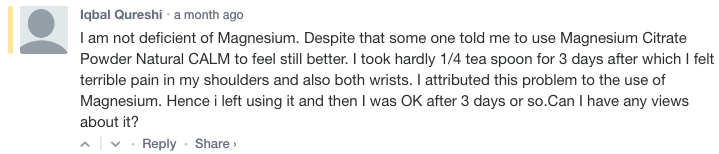
No wonder it caused negative effects for him, he wasn’t supposed to be taking it in the first place.
One person might say that smoking marijuana fixed everything for him.
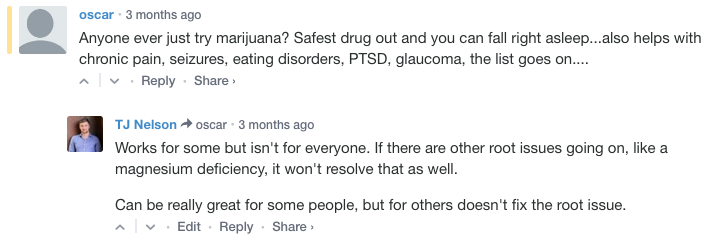
However, if I was to go smoke marijuana myself I would fall down a rabbit hole of despair within 3 days and get wrecked.
Some people get frustrated when some supplements work and some don’t work.

However, this person is actually on the right track! All the supplements that he took that didn’t work aren’t related to his root causes. That gives us clues to what he does and doesn’t need. If methyl b12 and magnesium is working, why is that making him feel better and what does that mean to get to the next level of healing?
You should always be asking yourself what causes depression for you.
If you try something and it doesn’t work, that is a good thing. That means you ruled that out and are one step closer to success.
Everyone has different causes for their depression. One person might have mineral deficiencies. One person might have heavy metal toxicity. One person might be allergic to gluten and eating so crappy for decades that their body can’t function anymore until some kale and spinach gets put in that belly. Another person might have a chronic Epstein-Barr virus infection, adrenal fatigue, leaky gut, and stress problems.
Each one of those people are going to have very different methods that work for getting better.
Hell, one person might just be a bit low and start taking cold showers or doing cryotherapy to feel better.

Why are we so focused on symptoms, band-aid solutions, proclaiming a one size fit-all approach, and little tricks instead of focusing on the truth about what causes depression?
Let me ask you a question.
What do you think would get more people to opt-in to a program?
If I said, “This One Little Supplement Cured 98.4% of All Depressed People That Took It!” or if I said, “Figure Out Your Depression’s Root Causes with Testing, Get On a Plan To Fix Them, and Beat Your Depression Long-Term by Changing Your Diet, Lifestyle, and Sleep.”
Exactly, the first one.
Is it easier to try to learn a trick or actually do the work? I
Is it easier to be sold “just take this pill” or is it easier to be sold, “Learn what causes depression for you, stop eating junk food and drinking coke, eat a lot of vegetables, get 8-9 hours of sleep, get a bunch of testing done to rule out deficiencies?”

“I’ll See You In Four Hours”
Easy and quick solutions sell a lot because our brains are hardwired to be lazy and do the least amount possible to get a desired result. You wouldn’t want to walk to your friend’s house in 4 1/2 hours when you could drive there in 28 minutes would you?
That’s why when we hear of a pill that can cure everyone, we want to take it. Our brain thinks, “Oh wow, that’s easy and won’t use too much energy so I can use that energy elsewhere for survival instead.”
Along with the myth that depression is simply a chemical imbalance and the push for antidepressants everywhere, people are confused as to what depression really is and how to actually fix it.
People usually only find my site after they take antidepressants for a while and realize they are still having a hard time.
It’s simple. If someone needs vitamin d and to fix their adrenal glands, anything other than correcting their vitamin d deficiency and getting their cortisol secretion on track will fix their depression.
It’s just harder to figure out what causes depression for you and implement the solution than it is to feel a symptom and get something quick that will just help the symptom.
Let’s say your house is filling up full of smoke because of a fire in the living room. This is causing you to choke and cough.
Taking a quick pill or looking for the quick solution is like focusing on the smoke and opening the windows so that you aren’t coughing anymore.
Focusing on what causes depression and fixing the root causes is like hitting the fire with a fire extinguisher so that there is no smoke production to begin with.
 You must be focused on what causes depression for you and know that you have to figure that out to have depression relief long-term.
You must focus on your own personal physiology and figure out what works best for you instead of assuming one solution is the answer for everyone.
Once you adopt this mentality, everything will change for you and you’ll start to see depression for what it really is.
If I start to feel bad, instead of thinking, “Oh no! Depression has gotten a hold of me!” I instead think, “Hmm… what is happening that is making me feel that way?” Figure out what that is, and then fix it.
Let me know in the comments what you’ve done to figure out what causes depression for you and if you have any questions.

Finally! You’ve found the cure to your depression!
You read about something new and you just feel it in your bones.
You’ve tried it all already and you know this should do the trick!
But then it might work for a moment, and you find yourself right where you started.
You’re still stuck in crippling depression and that’s when it hits you.
You’re doomed and there is nothing you can do.
You’ve relapsed over and over and over and nothing has worked. You then think, “Depression is forever.”
It doesn’t help that the societal norm is to believe depression is a disease and that you have to take pills like a “diabetic has to take insulin.”
Psychiatrists told me that all the time. I was told that my depression was so bad that I would have to take antidepressants for the rest of my life.
What do you think doctors would say if I told them that I fixed my diet, corrected nutritional deficiencies, restored my brain using amino acids instead of having to take Celexa, and when the root causes were fixed my depression was gone?
They would probably just write me off as a random recovery case.
The thing is, by its very definition, depression makes you think that depression is forever.
Depression places a “filter” over your thoughts. I know that even as I am writing this, a lot of this isn’t going to register until you finally feel better.
This filter produces all-or-nothing thoughts. Many of which are simply not based in reality.

When depressed, everything you see looks different
Since you are depressed, you can only see the supporting reasons why depression is forever. This is how depression creates a downward spiral and feeds itself. Some people don’t even believe me when I say I had depression for 11 years and now I don’t. I also understand exactly why they don’t believe me, because when I was depressed I wouldn’t believe that either.
Here’s the simple truth. People are recovering from depression all the time. You just have the “filter” over your thoughts. You most likely read depressing stories online. Whenever you search about depression you see horror story after horror story. When you search about people getting off of antidepressants you really see horror stories.
Other than having the “filter” that depression causes to your thoughts, there are two main reasons why we don’t remember or see the success stories.
The first reason why there is an abundance of negative stories when it comes to healing from depression is that the brain will focus on negative events instead of positive events.
Have you ever watched the news? What do they report on? Do they ever say, “In the east part of town, three teenagers started a fund and rescued a group of dogs that are now happy in new homes?” Never, because that isn’t what the brain responds to. People would watch the news channels that showed car accidents and wars and the happy news channel would quickly go out of business.
Why is that?
For survival reasons, our brains are impacted more by negative events and things rather than positive ones. This is because it is better for survival to remember that someone died by a lion next to the river than it is to remember that there were pretty flowers by the lake.

Would you rather remember where the flowers are, or avoid this situation?
Our brains focus on the negative and get stimulated by them because that helped us survive as a species.
This makes it even harder for people with depression (who have “the filter”) to see that people are healing from depression. It is more memorable to see all the hopeless stories on forums.
That’s why when Robin Williams died, everyone emailed me saying that if he had that much money and fame and still committed suicide, that meant that they had no hope to recover.
The truth is, it’s probably harder to deal with life when you have fame like he did. Not to mention I fixed my depression when I was completely broke. Robin Williams was also just one man (and they are now saying he had a rare brain disease on top of all this), yet seeing this one well-known man commit suicide makes it seem like it is impossible to heal from depression.
Our brains see the death of someone like Robin Williams and is highly impacted by it despite the thousands of others that are healing their depression while you read this post.
The second reason that you don’t hear about as many positive stories is that people will post all day about their pain when they are in depression, but when they fix it they just go on with their lives and they don’t want everyone to know that they were depressed.
I have a lot of people take my program or use my site and email me telling me that they are better now and are excited to be living life.
A lot of these people I will never hear from them again. The ones that I email asking if they would like to write a success story usually don’t want to go public about having experienced depression.
This causes a lot of the success stories to go unnoticed. Some people get major depression and largely keep it a secret, fix it, and then go on living their lives and don’t look back. Others don’t want to put their name out there on the internet and want to keep their anonymity.
It makes sense for a lot of people that once they fix their depression they get to move on and not think about it anymore.
When I first started working with people and created this site, it was hard for me thinking about my own depression. I’ve done it long enough now that someone can email me in a really bad condition, I can help them in the best way possible, and I can do that without starting to feel what they feel.
The truth is, success stories are out there. I get emails from people all the time about them healing from depression. I get private Facebook messages from people telling me they were depressed for years and then finally figure it out. At the beginning of my Start Here page I have several success stories posted from people that just visited my site and were willing to put their stories out there.
Hundreds of people are healing from their depression right now. They just don’t want to go out telling the whole world about their dark past.
If it isn’t forever, how long depression last?
People also ask me how long it will take until they feel better and aren’t depressed anymore.
The answer is that it depends.
I’ve seen some people heal themselves in a matter of weeks. I’ve seen some people take a year to just for the withdrawal effects from Nardil wear off.
How long depression will actually last all depends on how severe your root causes are and how long it will take to fix them.
Someone that simply has a vitamin d deficiency can fix their depression very quickly whereas someone with SIBO, parasites, low thyroid, Epstein-Barr virus infection, and allergies to food will take longer.
The thing is, even if it does take you a year or two to fully recover, it can still be done.
Here’s the truth. Depression can be fixed. Thousands of people are doing it everyday. Depression is caused by something. You just have to find the root causes for your depression and fix them.
But let’s just pretend that maybe depression can be forever. What if it isn’t always fixable?
Either way, if you have depression, you have two options. You can either keep testing, trying new things, and going until you succeed. Or you can give up and accept your circumstances and never feel good again.
I don’t know about you, but even if it took me 10 years to figure it out, it would still be worth it.
Depression makes it really hard to do anything. I remember at times it was almost impossible to even just brush my teeth.
The most powerful thing I ever did, was tell myself I was going to go all out for a year and try everything, do anything, and test any approach until I found the answer.
Even if it was the smallest baby step forward, I would do it. I had to. I had no other choice. I either figure out my depression or I would die trying.
You can either keep moving forwards and trying new things, or give up. The choice is yours.
But we all know that as long as you don’t give up, things will get better, regardless of how long it takes.
The biggest lie depression tells you, is that it is forever.

 Your alarm goes off.
As you try to wake up, you can’t shake the feeling that the day is going to be hard.
Then the thoughts start coming in, like a river of self-hatred.
“Why can’t I beat this depression?”
“I’m worthless, everyone around me thinks I’m a drag.”
“What’s wrong with me?”
“If I was stronger I could just feel better.”
“Is this actually real or am I just imagining things?”
“Maybe I need to fix my thoughts. I just haven’t mastered changing my thoughts yet. Damn, there was another negative thought… Mentally I must be weak.”
“I’m a bad person.”
Notice a common theme here?
Tim comes over to pick you up in his run-down car.
As you get in, he tries to start it. All you hear is that quick clicking sound, signaling the battery might be dead.
All a sudden Tim hits the steering wheel and says, “Why can’t I just start this thing! What’s wrong with me!” You look over at him and you can see his self-esteem plummeting.
Finally the car starts, and as you are driving it hiccups, lunges forward, and every bump feels like you’re on a rollercoaster ride. Tim then starts assuring you, “Sorry, I’m such a horrible driver. I just can’t seem to drive straight at all.”
You look at him a little perplexed, wondering why he’s blaming himself for all this.
Seeing the look on your face, Tim says, “Sorry it’s hot in here, I suck at working the air conditioner. If I could just push the buttons right it would probably be cold in here.”
Then suddenly after 10 minutes the car dies in the middle of the road, and its hot outside. As you both get out of the car to check it out, instead of looking under the hood and diagnosing a mechanical issue, he proclaims, “Look, I’ve been trying to think positively about getting to our destination and failed! It’s all my fault. If I was just stronger we would have made it. I’m such a shitty and mentally weak person.”
Finally you look at him and slowly say, “Tim… What does this have to do with you? Don’t you just need to get your car fixed?”

It Would Be Hard To Get Anywhere In This Car
When you read the story about Tim and his car, what was your impression of him? Did you wonder why he was being so hard on himself, when all he needed to do was get a new battery, put coolant in his radiator, and fix his car’s suspension?
The problem with depression, is a lot of people just don’t understand what it actually is. Depression is the state you find yourself in when your brain and body aren’t functioning properly. Simply trying to think positive won’t work.
For most people, they use the word “depressed” when they are in reality just “sad”. That’s why they can go for a jog and the “depression” just goes away, and why they tell you to just snap out of it. For them, they actually can snap out of it, because it is just sadness.
This becomes dangerous when you start to believe the same thing and you are actually depressed. When you believe that the depression itself means there is something wrong with you, that you should be able to shake it off, and just keep going, is when you get trapped in a downward spiral of despair.
The key is to realize that depression isn’t “you” and it doesn’t mean you are in anyway a bad human being. It doesn’t mean that you are mentally weak and you just haven’t had the strength to fix your thoughts. That’s like telling Tim he’s a bad person and to just think positive and his car should run better. It won’t run better until he fixes the root causes of what’s wrong with it mechanically in the first place.
There is absolutely nothing wrong with you if you are experiencing depression. Something is just off.
The depression isn’t you. There is a root cause. Something happened physiologically and it is now affecting your mental state, like your body is sounding off an alarm.
This alarm could be that you’ve been working 18 hours a day for too long and now your cortisol can’t keep pushing you forward. This alarm could be that you’re deficient in magnesium, need more vitamin d, and are allergic to gluten and you eat bread every morning for breakfast.
When you are bombarded by these negative, maybe even suicidal thoughts, realize that these are not your thoughts, there is something going on chemically that is producing those thoughts.
Once you are able to separate yourself, accept yourself exactly as you are, and see that a fact is a fact, that something is run down and needs fixing, then you can get rid of all the stress of beating yourself up.
This correct perspective allows you to deal with the depression without being overwhelmed.
Now that you know that depression isn’t you, it’s time to actually fix it. It’s time to actually take the car to the shop and replace some parts and change some oil.
There’s a fine line between acknowledging that depression isn’t your fault and being a victim.
You don’t want to sit back, accept that it isn’t your fault, and do nothing about it.
You also don’t want to hope that someday someone will magically fix it for you.
Nobody is coming to save you.
People can give you directions and guide you, but you have to actually do it. Tim has to get out his tools and go under his car and start troubleshooting what’s wrong with his vehicle.
You have to take an active role in doing whatever it takes to fix your depression. You have to accept that yes, being depressed means nothing about who I am or what I am capable of, but I do have to do whatever it takes to fix it now.
The reason I was able to fix my depression is I made a commitment that I would do whatever it takes to fix it no matter what.
This meant I could now read any book. My mind was open to any approach. I realized that I should place value on investing my money into getting tests done, seeing the right people and paying for their time, buying healthy food and trying out different supplements, and going at it until the problem was fixed.
I had to look under the hood, try out different things and keep going, until I figured out what was wrong and what could fix it, until the engine started firing on all cylinders.
That same year that I made that decision to do whatever it takes was the same year that I started to finally glimpse what life was like on the other side, of not being depressed and wanting to blow my head off every single day, and what mental clarity was like after living with brain fog for so long. I was able to get off Celexa and learned how to properly get off of antidepressants.
Every car is different, just like every person is different. There can’t be any one single supplement that cures everyone, because depression is caused by so many different things. You have to find out what your own root causes are. There are a thousand different reasons why a car won’t start, you just have to figure out which ones are causing your car not to start.
The depression was never actually “me”. My body was just out of balance. I was trying to force a run down car to drive somewhere, and I never stopped to realize maybe the car just had some broken parts.
Topics Discussed:
0:14 – Supplements I Took Before Bungee Jumping
0:38 – What I Experienced Jumping Off the Platform
0:50 – Skydiving Years Ago When I Was Depressed
1:26 – The Day I Realized Depression is Real
2:01 – Bungee Jumping Compared to Depressed
2:34 – Keep Trying New Things to Fix Your Depression
No I am not going to tell you to go bungee jumping to fix your depression.
Bungee jumping doesn’t fix your depression anyways. It might fix sadness, but not depression.
I recently attended a large business event. One of the speakers was extremely successful and well established.
We find ourselves in the elevator together and start talking while we go to eat lunch at one of the best buffets I’ve ever had in my life.
As we were walking, we started talking about this website and how I want to help people cure their depression.
He tells me how he has gotten depressed a few times and I began to start my story about skydiving.
He cuts in and says, “Oh yeah! Whenever I start to get depressed, I just go skydiving or do something crazy and it solves it.”
I say, “No, that isn’t depression then.”
And he responds, “No! It’s true! Research shows that doing something like skydiving elevates your dopamine levels hours afterwards.”
I then proceed to tell him my skydiving story…
The guy is awesome and there is absolutely nothing wrong with what he said… But this is just one more case of people misunderstanding the word “depression“.
We need to create a new word for depression. So many people confuse sadness or feeling down with depression.
If you feel down for a few days, you are not depressed.
Depressed is feeling like crap for weeks, even months at time. Depression is feeling like shooting your head off for months at a time.
There is a massive difference between feeling down and wanting to blow your head off. That is where a lot of misunderstanding about depression comes from. There is a wide range of states along the depression spectrum. You don’t necessarily have to want to blow your head off with a shotgun to be labeled as depressed.
But depression is a state of mind that you cannot get out of for at least a few weeks. And it can’t be solved by jumping out or off of high things. That is why it is depression in the first place. Depression IS not being able to enjoy those things.

I eventually crashed and didn’t get hurt at all, but that’s another story.
Go back about 5 or 6 years. I have a Yamaha R6, a motorcycle that you will instantly be liable for a reckless driving ticket just by twisting your wrist a few centimeters. I drive it around going above 100mph every time I ride it.
I hit corners so fast it feels like my bike is an ice skate capable of cutting into the asphalt and maintaining traction where ever I go.
I chase adrenaline wherever I go. At night on the highway I race other bikers just to see who’s bike is faster.
When I get home the hairs on my arm are all sticking up because of how fast I was going. I could barely even make the corners while staying in the same lane because of how fast I am going.
I’m still depressed.

I eventually crashed and was almost paralyzed, but that is another story.
I participated in all sorts of crazy extreme sports. I played ice hockey where in my championship game someone got knocked out cold and sent to the hospital.
I mountain bike with my friend who is way beyond my skill level and hit jumps I shouldn’t be hitting.
I ride dirt bikes in the sand dunes as fast as I can.
I start hitting the biggest jumps I can find at the ski resort on my snowboard.
I have this weird belief that this is what I need to do to cure my depression… yet….
I’m still depressed.
So back to the multimillionaire. About 6 years ago I am training to be certified in skydiving so that I can go on solo jumps as much as I want… to fix my depression.
It is all good and fun, and I think everyone should go at least once, but the fourth time I jumped, something happened.
On the drive to the skydiving place, I feel nothing.
On the way up in the plane, I feel slight nervousness.
I jump out the plane with my own shoot… I free fall for almost a minute. I pull my shoot, glide down to the ground, turning perfectly into the wind and pulling on my chute at just the right time.
People run up to me in excitement, but slowly their excitement turns to an awkward surprise.
When they ask me how it was, I shrug, “it was ok.”
I didn’t enjoy any second of that jump and was almost even more depressed on the drive home.
When I got home, I realized, “I just went skydiving and I still feel like pure shit. I think I have depression.”
You think?
Depression was a state of mind I was stuck in that was blocking me from feeling pleasure from even the most extreme experiences.
That is the day I realized just how real depression is. I had depression and I needed to do something on a deeper level than just ride fast motorcycles and jump out of planes.
So instead I started bungee jumping and that solved everything….
Just kidding.
Flash forward to now. I went bungee jumping with my Vietnamese friend in Thailand.
The night before I was still adjusting to the time zone difference, so I took an L-Tryptophan at night and in the morning I took an L-Tyrosine.
As we are driving to the spot, I am nervous and excited.
As I am buying the ticket, I start to feel surges of anxiety and excitement.
I’m going up the crane and I feel so nervous I am legitimately worried that I am going to pee myself.
I jump off the platform as the employee counts to three in Thai and fall towards the water at the bottom in what must have been one of the most adrenaline surged experiences I’ve had in a while.
Afterwards I’m elated and excited, replaying the experience in my head.
On the drive home, that’s when I realized I had fixed my depression for real. I wasn’t just running from my negative states trying to surge myself with the craziest things out there.
I had fixed my depression through repairing my brain and body on a deeper level with vitamins, minerals, amino acids, and healthy food.
I felt so grateful looking back comparing my experience with jumping out of a plane and feeling nothing to jumping off a small platform where I felt everything.
If you haven’t yet fixed your depression and haven’t taken a deeper look into nutrition and supplements, then do it now.
P.S. If you liked this post, please let me know if something about my journey with nutrition and supplements would be interesting. I am contemplating writing a book or course on it, but I only want to create something if it will be valuable to people.
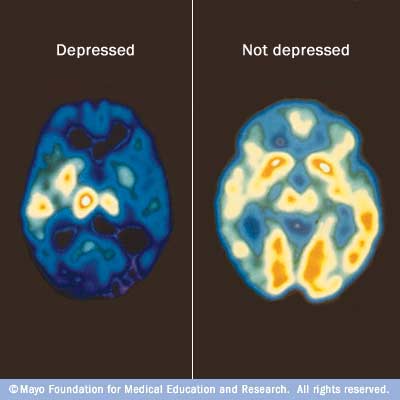
Depressed Brain Scan – Thanks to MayoClinic.org
Ever heard “Think and Grow Rich”?
“Think positive and you’ll attract what you want.”?
People ever tell you, “Just be grateful for all the wonderful things in your life”?
That you are depressed because you are thinking too negatively about everything?
So why don’t you just change your thoughts then buckaroo? Quit complaining and start being positive!!!
And you try. And try. Try a little more.
But you’re still depressed.
Why is this? Why is it hammered into our heads over and over again that positive thinking will solve our depression problems? Are these people crazy or are we just mentally weak? Morally incapable? Deficient human beings with character flaws?
The problem has nothing to do with positive thinking. The problem has to do with a misunderstanding of depression. Most people think that depression is a matter of cognition. It is all “in your head.” And if you are depressed and believe that, you are in for a long frustrating ride. If depression isn’t caused by your thoughts than what causes it?
More on that in a minute. But first let’s take a look at Amazon.com and some of the best selling novels when you search “depression.” There is a great book by David Burns called Feeling Good that teaches cognitive therapy.
But, as a reviewer of the Feeling Good Handbook pointed out:
When your head’s on fire, the book “Feeling Good” is only going to make you feel worse.
This book was a great read–when I wasn’t depressed or anxious. In fact, I recommended it to my clients all the time. I even attended a great workshop by David Burns, who–by the way–is a fantastic presenter.
The problem is that the book was useless when I was suffering from severe anxiety and depression. I’m not knocking cognitive therapy. It’s highly effective–as long as a person’s prefrontal cortex is working. But when your body aches, you can’t eat or sleep, and you wonder how you’ll get through another minute without ripping your skin off, this book is not going to help you. Save Feeling Good for when you’re feeling good enough to focus on it!

Mood Problems Feel More Like Your Head Is On Fire Than Failing To Think Positive
When a person hears about positive thinking they go crazy with it. It usually begins with stuff like, “I’m awesome!” or “I’m a badass!” or “I am the most amazing delicious little dumpling that ever came out into this earth headfirst!”
Could repeating that over and over all day work?
Not if you are depressed.
There is a better way.
I found this person’s plea on Yahoo Answers:
I’m reading the Feeling Good Handbook right now, only halfway finished. it has some good stuff in it, but like other books I’ve read, it tells you that your thoughts contribute to your feelings…duh! but how do you get rid of these depressing thoughts…that is the million dollar question!
Thinking positive is like using a supplement for weight loss. When the nutrition and exercise is in place, the supplement can really help shed off those last few pounds.
But if someone is eating like shit and sitting on their ass all day, all the green tea extracts in the world won’t do a thing.
If someone is going to the gym two to three times a week, dialing in their diet, and allowing proper recovery, they have the foundation for weight loss. These things will account for 80-90% of results.
This person shouldn’t even be worrying about raspberry ketones until they have the basic fundamentals. The raspberry ketones by themselves won’t do a damn thing.
If you are in a deep depression one positive thought is not enough to change your brain chemistry. Not only that, but isn’t thinking positive hard while depressed? Isn’t that a symptom of depression?!
I tried the Positive Thought challenge multiple times back when I had bad depression. I even wrote extensively about it on an old blog that I had. It was a lot of effort and just wasn’t sustainable.

Sitting down to meditate is so basic yet so hard.
You can change your thoughts over time.
But consider this.
How many westerners sit down to meditate each day?
…read that again.
How many westerners sit down to meditate each day?
If we can’t even sit still on a chair and simply be aware of our thoughts for 5 minutes without being restless, how are we supposed to control our thoughts for the entire day when we are caught up in other activities?
If we can’t focus for 5 minutes in isolation, how are we going to focus for 18 hours on our thoughts when driving through violent traffic and working at our fast-paced jobs?
Changing your thoughts can change the state of your mind…
But what about changing your state of mind to change your thoughts?
What if instead of trying to change our thoughts, we did something else that in turn affected our thoughts?
Lets look at the most popular method for treating depression in Western Society – antidepressants.
Antidepressants work because they change the chemistry and thus the state of our mind. The most common antidepressant is an SSRI, which blocks the re-uptake of serotonin in our brain. This means that our brain will have more serotonin floating around to use. More serotonin changes our mood.
Changing our mood allows us to think clearly and think positively.
Suddenly we don’t feel like absolute shit. Finally we are able to actually see the good in ourselves.
I took citalopram (Celexa) for a little over half a year and it definitely saved me. At the time I needed it to lift the fog so I could simply function. After a while, however, the effects slowly stopped working, but that is another story.
At the time no amount of positive thinking was going to fix the serotonin deficiency in my brain causing the negative thoughts in the first place! It wasn’t until I took something that altered my brain that the negative thoughts began to fade to where I could see some light.
Here is another great example of when changing our thoughts just isn’t possible. Recently I spent many months of my life in fight or flight mode, aka “survival” mode.
The only thing I could think about was making the money I needed to survive.
Everything was a threat. Everything made me nervous. I couldn’t relate to people anymore.
I literally could not escape that state no matter how much positive thinking I did. I couldn’t relax using meditation or other methods like breathing.
I was in that state of fight or flight.
It wasn’t until I really took control of my financial life and taking supplements like Valerian Root to calm me down that I was able to escape it. It wasn’t until I calmed down my “mind that was on fire” that I was able to start to use other techniques like positive thinking.
Once I started to finally ease out of that state, I started taking a few supplements, eating really healthy, and exercising again.
I finally tackled my sleep to where I was getting the rest I needed.
I began investing in my relationships and getting the support I needed from family and friends.
Now it is a totally different ballgame. Changing my thoughts beforehand would not have worked. My mind was racing and there was nothing I could do.
But when I changed the state of my mind through nutrition and rest, my thoughts became more positive.

Vodka – A Depressed Person’s Depressant
What does it mean to be in the state of depression?
Imagine this.
You and your friend are sick of your jobs and Friday night finally hits. Your friend comes home and surprises you with a nice bottle of vodka. You don’t particularly like vodka but whatever, it’s Friday night baby!
Talking about your jobs you both realize maybe you have drank a little too much. About 10 shots in you realize you are hammered. You turn to your friend and say, “Think sober thoughts!”
Your friend is still going to be drunk no matter what he or she tries to think.
It isn’t going to happen. Your friend is drunk. The only way to get out of that state is to remove the alcohol from your friend’s body.
Why do people think depression is any different?
If you actually think that depression is different, look at the brain scan again at the top of the page. A depressed person’s brain is far less active than a not depressed brain.
If you have been hard on yourself because you feel like you have failed by trying to use positive thinking to cure yourself, take a step back. Look at the brain scan again. Sigh a breath of relief.
Now really think about what you need.
Ask yourself, “What is this depression telling me?” Is another positive thought going to change an entire brain that has decreased activity? How is your food affecting you? Are you getting enough sleep? Are you focusing on the right actions? Are you getting the help you need?
Quit worrying that you are immoral or “weak” that you are depressed. Use the depression as a signal that you need to take action in a certain area of life.
Maybe you are allergic to dairy and you’ve been drinking a half gallon of milk everyday and it is making you feel like garbage.
Maybe you need to use amino acids and vitamins to restore your nutrient levels so your brain can function again.
If you feel good, relaxed, and healthy, it is a lot easier to think positive.
When I feel that way I don’t even have to try to think positive – it just happens on autopilot.
Again, I’m not saying you shouldn’t learn the cognitive aspect of depression.
But if you’ve already learned it and are still depressed, there are many other areas you can tackle. Don’t give up because you “failed” at positive thinking.
I’ll make every negative thought red and every positive thought black.
When I’m feeling depressed my thought process looks like this, “I should’ve done way more yesterday. I probably won’t ever amount to anything. What’s the point if we are all going to die anyways? Joe is annoying, plus he dribbles a basketball weird as hell. Money is evil.”
When I’m feeling good, my thoughts become, “I’m awesome. I’m feeling great. I wanna call Joe and take advantage of his weird basketball dribble. I want to travel. I’m worthless. I want to start a business. I think I might go for a run tomorrow.”
Did you catch the negative thought? It is pretty easy to catch those thoughts and turn them around when there are few of them. As far as the first scenario, it is pretty hard to change a whole army of negative thoughts when you are deep down the rabbit hole of depression.
And if you ever felt a little weird trying to pump yourself up with thoughts like, “I am amazing,” I did too.
Now I just stop and question the reality of statements. “No girl would ever want to date me.” Is that true? Am I actually unattractive to ALL women? Even though this girl liked me, this girl liked me, and this girl liked me…? Maybe some girls do like me… Glad I kicked Joe’s ass in basketball this morning.
Negative thoughts can be a symptom of feeling like shit. Negative thoughts can make you feel like shit. Positive thoughts can be a symptom of feeling good. Positive thoughts can make you feel good.
If you are depressed, you should be spending your time figuring out what the root cause of your depression is. If you feel like crap everyday despite thinking positive, something else is wrong.
You need to see if you have any vitamin deficiencies. You need to check your thyroid, sex hormone, and mineral levels. You need to see if you have enough Vitamin D.
You can restore your neurotransmitters naturally with amino acids. You can start sleeping again with natural supplements and by eating right.
And you can start waking up without feeling like your head is on fire.
You can change your state and actually fix depression instead of trying to think positive and faking like you are alright.
I hope you enjoyed this article and realize that positive thinking isn’t the big solution we make it out to be. If you’re struggling to find real advice on how to recover from depression without medication, click here to sign up for daily emails that give you truthful and actionable steps to feel like your old self again (plus a free bonus).